Download original PDF · Plain-text extract
Every original page is reproduced below, including all illustrations, tables and labels. Select a page image to open it at full resolution. Expand Text for copying and search below a page to read its extracted text; extraction may change spacing or special characters.
Page 1
Text for copying and search
FF-OI-11:  “Damage  system”
Rev(01)

Feldfeste  Operation  Instruction
 FF-OI-11:  “Damage  system”    Document  History   Revision  Content  Editor  Time  01  Initial  Document  Creation  Arina  23.06.2026
Confidential  Operation  Instruction
Page 2
Text for copying and search
FF-OI-11:  “Damage  system”
Rev(01)


Table  of  Contents  Overview .................................................................................................................................. 3 CA  Damage  Type ..................................................................................................................... 4 Implemented  DamageTypes .............................................................................................. 4 Damage  Delivery  Type ............................................................................................................. 5 Piercing  damage ...................................................................................................................... 6 Damage  Dealer  Interface ......................................................................................................... 7 Status  Effects ........................................................................................................................... 9 When  adding  a  new  effect .................................................................................................. 9 Implemented  Effects ........................................................................................................... 9 Status  Effect  Target  Interface ................................................................................................. 10 Defense  component ............................................................................................................... 11 Damage  calculation ................................................................................................................ 12 Stats  involved  in  damage  calculation: .............................................................................. 12 Damage  pipeline .............................................................................................................. 12 Effect  Damage .................................................................................................................. 14 Kinetic  impact ......................................................................................................................... 15 Attack  speed .......................................................................................................................... 16 Anim  notify ............................................................................................................................. 17

Confidential  Operation  Instruction
Page 3
Text for copying and search
FF-OI-11:  “Damage  system”
Rev(01)

Overview
This  document  describes  the  damage  and  status  effect  system  architecture.  The  system  is
designed

to

be

data-driven

and

extensible

—

adding

new

damage

types

or

effects

requires

no

changes

to

existing

code.

Damage  is  defined  by  two  independent  dimensions:  what  kind  (CA_DamageType)  and  how
it

is

delivered

(E_CA_DamageDeliveryType).  All  damage  calculation  happens  in  HealthComponent —  via  OnTakeDamage for  incoming  attacks  and  ApplyEffectDamage
for

effect

tick

damage.

Delivery

type

and

piercing

data

are

retrieved

from

the
 DamageCauser via  the  Damage  Dealer  Interface.
Status  effects  are  self-contained  ActorComponents  added  dynamically  to  the  target.  The  Status  Effect  Component acts  as  a  manager  —  it  creates,  tracks,  and  removes  effects.
Each

effect

handles

its

own

behaviour

and

lifetime

independently.

Defensive  stats  live  in  the  Defense  Component,  which  provides  resist  and  block/evade
modifiers

as

simple

lookups.

Final

damage

is

calculated

from

these

modifiers

with

no

branching

logic.

Actors  that  can  receive  status  effects  implement  the Status  Effect  Target
Interface
 to  handle  visual  and  gameplay  reactions  without  coupling  to  specific  effect
classes.

Key  Concepts
●  CA_DamageType  —  defines  the  nature  of  damage  (Physical,  Fire)  ●  E_CA_DamageDeliveryType  —  enum  defining  how  damage  is  delivered  (Melee,
SmallProjectile,

LargeProjectile)
 ●  Damage  Dealer  Interface  —  implemented  by  DamageCausers  to  expose
DeliveryType

and

Piercing
 ●  Status  Effect  Component  —  manager  component  that  creates,  tracks,  and  removes
active

effects

on

an

actor
 ●  Status  Effects  —  self-contained  ActorComponents  defining  the  behaviour  of  a
specific

effect
 ●  StatusEffectTarget  Interface  —  implemented  by  actors  to  react  to  effect  application
and

expiration

without

casts
 ●  Defense  Component  —  holds  defensive  stats;  provides  resist  and  block/evade
modifiers

as

Map

lookups
 ●  Damage  Calculation  —  the  pipeline  that  resolves  incoming  damage  into  a  final  value
using

attacker

stats,

defensive

modifiers,

and

damage

type.


Confidential  Operation  Instruction
Page 4
Text for copying and search
FF-OI-11:  “Damage  system”
Rev(01)

CA  Damage  Type
Base  class  located:  Content/CA_Code/Blueprints/DamageType/CA_DamageTypeBase.uasset
 Defines  the  nature  of  damage.  Used  as  a  key  for  resist  lookup  in  DefenseComponent.   Properties  ●  StatusEffectClass  —  optional.  The  effect  to  apply  on  hit.   Functions  ●  ApplyEffect  (public)  —  called  in  the  damage  pipeline.  Override  this  in  every
subclass

to

define

what

happens

on

hit.

Base

implementation

does

nothing.
 ●  BaseApplyStatusEffectImpl  (protected)   —  helper  implementation  that  passes
StatusEffectClass

to

the

target's

StatusEffectManagerComponent.

Call

this

from

ApplyEffect

if

the

damage

type

applies

a

status

effect.
  Adding  a  new  DamageType

Create

a

subclass

and

override

ApplyEffect.

Without

an

override

no

effect

will

be

applied.


Example:

CA_DT_Fire

overrides

ApplyEffect

and

calls

BaseApplyStatusEffectImpl

to

apply

burn.


Implemented  DamageTypes
●  CA_DT_Fire —  overrides  ApplyEffect,  attempts  to  apply  Burn  via  BaseApplyStatusEffectImpl  ●  CA_DT_Physical —  no  additional  effect  on  hit

Confidential  Operation  Instruction
Page 5
Text for copying and search
FF-OI-11:  “Damage  system”
Rev(01)

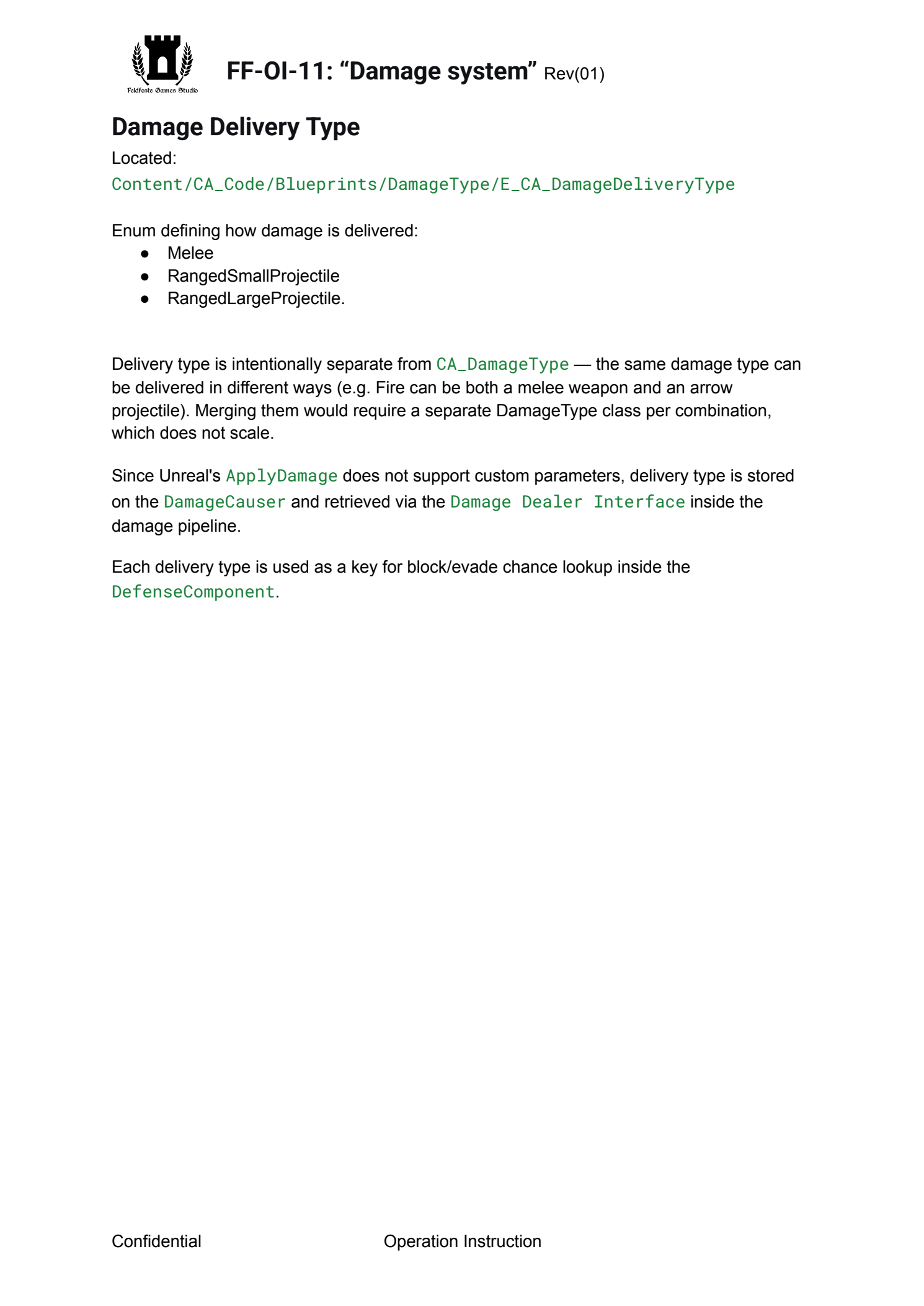
Damage  Delivery  Type  Located:
Content/CA_Code/Blueprints/DamageType/E_CA_DamageDeliveryType  Enum  defining  how  damage  is  delivered:   ●  Melee  ●  RangedSmallProjectile  ●  RangedLargeProjectile.
Delivery  type  is  intentionally  separate  from  CA_DamageType —  the  same  damage  type  can
be

delivered

in

different

ways

(e.g.

Fire

can

be

both

a

melee

weapon

and

an

arrow

projectile).

Merging

them

would

require

a

separate

DamageType

class

per

combination,

which

does

not

scale.

Since  Unreal's  ApplyDamage does  not  support  custom  parameters,  delivery  type  is  stored
on

the
 DamageCauser and  retrieved  via  the  Damage  Dealer  Interface inside  the
damage

pipeline.

Each  delivery  type  is  used  as  a  key  for  block/evade  chance  lookup  inside  the  DefenseComponent.

Confidential  Operation  Instruction
Page 6
Text for copying and search
FF-OI-11:  “Damage  system”
Rev(01)

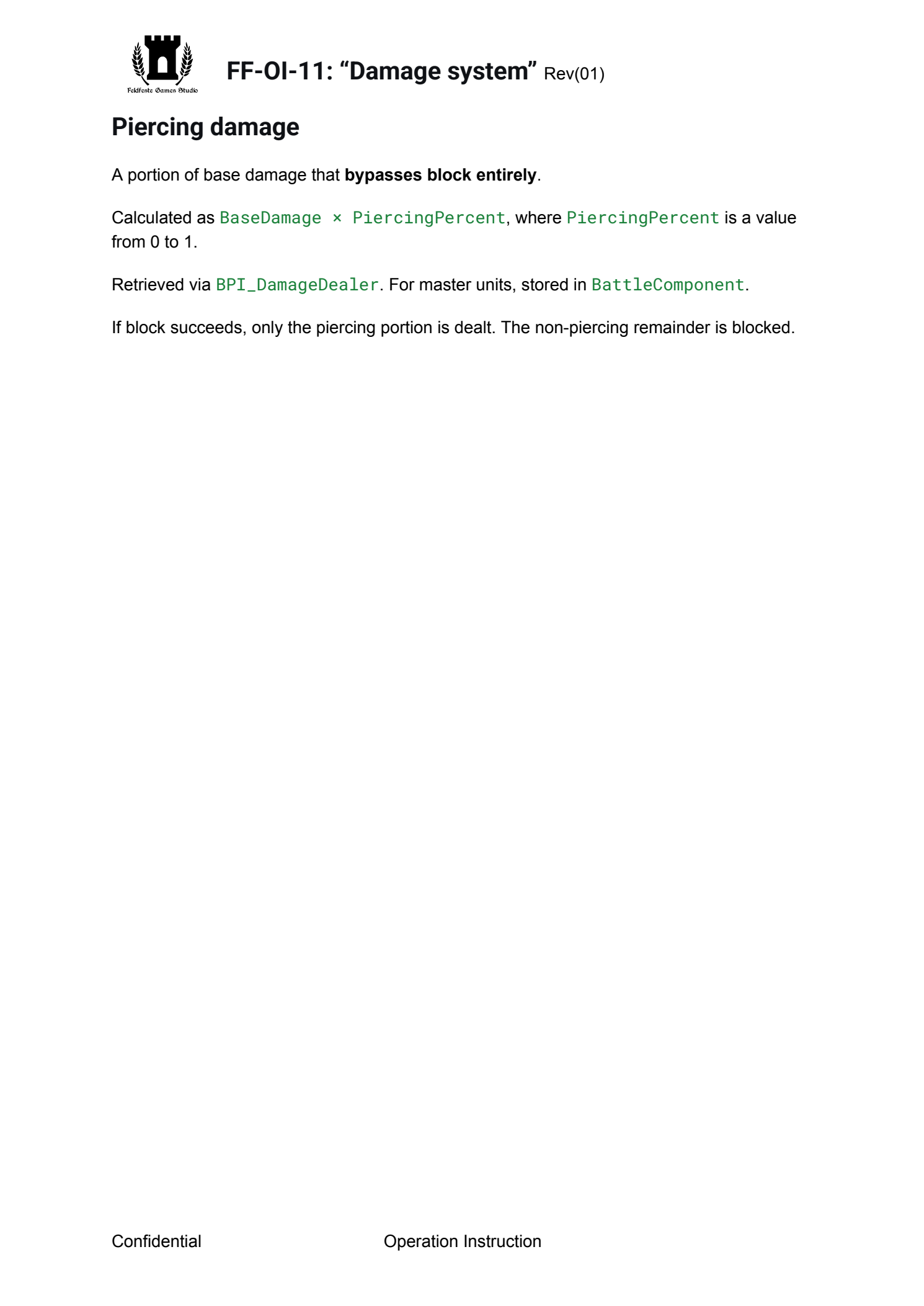
Piercing  damage
A  portion  of  base  damage  that  bypasses  block  entirely .
Calculated  as  BaseDamage  ×  PiercingPercent,  where  PiercingPercent is  a  value
from

0

to

1.

Retrieved  via  BPI_DamageDealer.  For  master  units,  stored  in  BattleComponent.
If  block  succeeds,  only  the  piercing  portion  is  dealt.  The  non-piercing  remainder  is  blocked.


Confidential  Operation  Instruction
Page 7
Text for copying and search
FF-OI-11:  “Damage  system”
Rev(01)

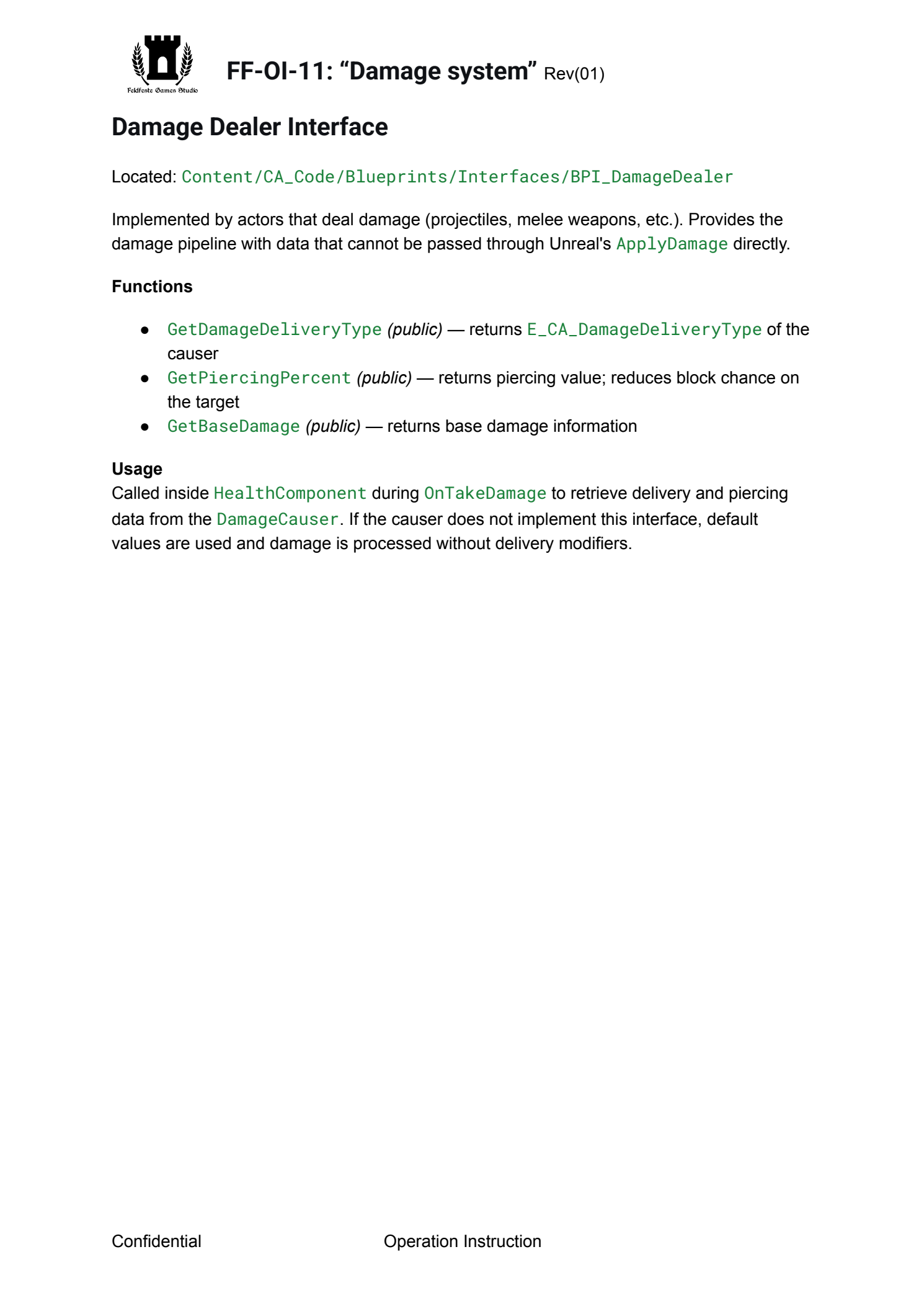
Damage  Dealer  Interface
Located:  Content/CA_Code/Blueprints/Interfaces/BPI_DamageDealer
Implemented  by  actors  that  deal  damage  (projectiles,  melee  weapons,  etc.).  Provides  the
damage

pipeline

with

data

that

cannot

be

passed

through

Unreal's
 ApplyDamage directly.
Functions
●  GetDamageDeliveryType (public)  —  returns  E_CA_DamageDeliveryType of  the
causer
 ●  GetPiercingPercent (public)  —  returns  piercing  value;  reduces  block  chance  on
the

target
 ●  GetBaseDamage (public)  —  returns  base  damage  information
Usage
Called

inside
 HealthComponent during  OnTakeDamage to  retrieve  delivery  and  piercing
data

from

the
 DamageCauser.  If  the  causer  does  not  implement  this  interface,  default
values

are

used

and

damage

is

processed

without

delivery

modifiers.


Confidential  Operation  Instruction
Page 8
Text for copying and search
FF-OI-11:  “Damage  system”
Rev(01)

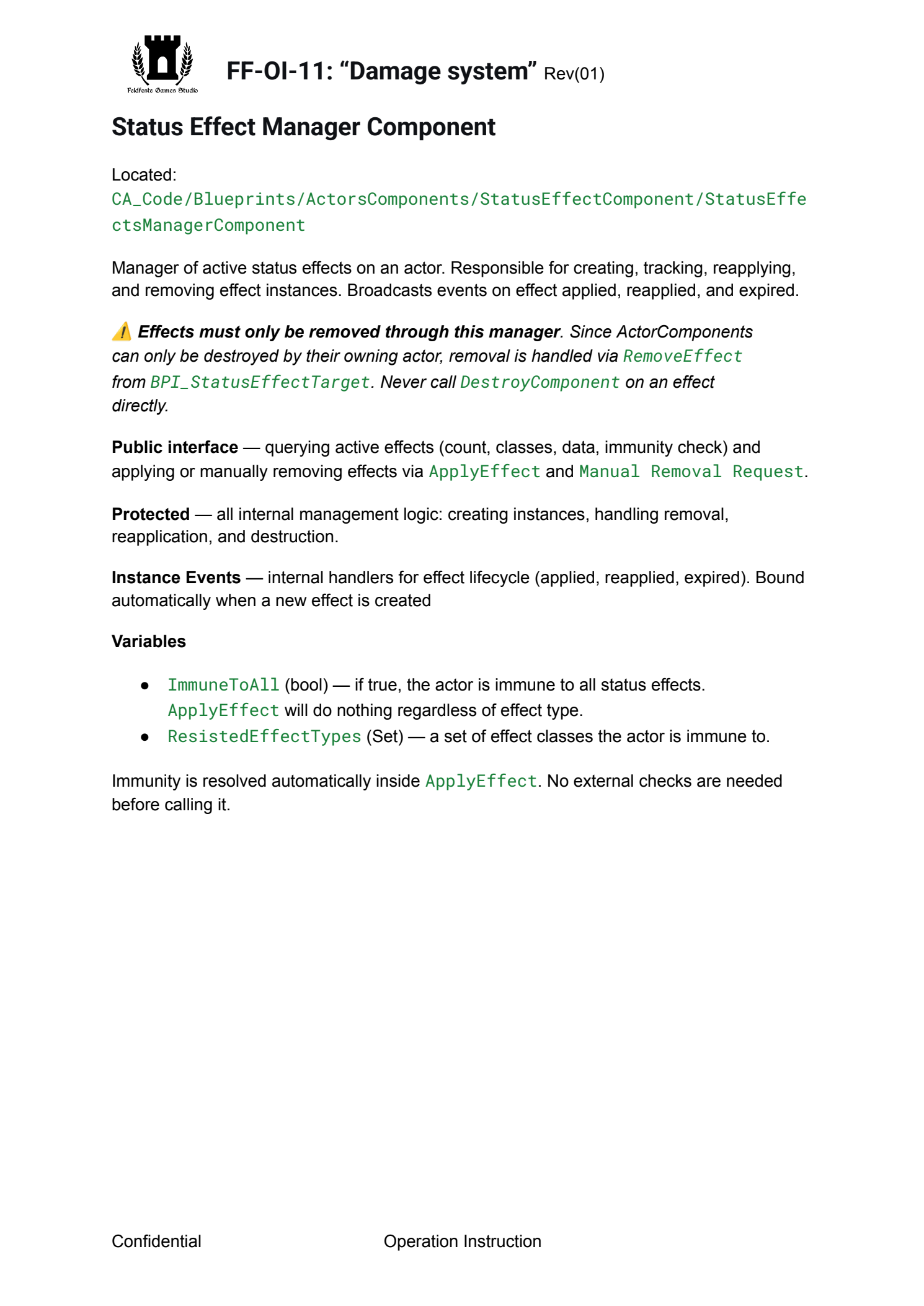
Status  Effect  Manager  Component
Located:  CA_Code/Blueprints/ActorsComponents/StatusEffectComponent/StatusEffe
ctsManagerComponent

Manager  of  active  status  effects  on  an  actor.  Responsible  for  creating,  tracking,  reapplying,
and

removing

effect

instances.

Broadcasts

events

on

effect

applied,

reapplied,

and

expired.

⚠  Effects  must  only  be  removed  through  this  manager .  Since  ActorComponents
can

only

be

destroyed

by

their

owning

actor,

removal

is

handled

via
 RemoveEffect
from
 BPI_StatusEffectTarget.  Never  call  DestroyComponent on  an  effect
directly.

Public  interface  —  querying  active  effects  (count,  classes,  data,  immunity  check)  and
applying

or

manually

removing

effects

via
 ApplyEffect and  Manual  Removal  Request.
Protected  —  all  internal  management  logic:  creating  instances,  handling  removal,
reapplication,

and

destruction.


Instance  Events  —  internal  handlers  for  effect  lifecycle  (applied,  reapplied,  expired).  Bound
automatically

when

a

new

effect

is

created

Variables
●  ImmuneToAll (bool)  —  if  true,  the  actor  is  immune  to  all  status  effects.  ApplyEffect will  do  nothing  regardless  of  effect  type.  ●  ResistedEffectTypes (Set)  —  a  set  of  effect  classes  the  actor  is  immune  to.
Immunity  is  resolved  automatically  inside  ApplyEffect.  No  external  checks  are  needed
before

calling

it.


Confidential  Operation  Instruction
Page 9
Text for copying and search
FF-OI-11:  “Damage  system”
Rev(01)

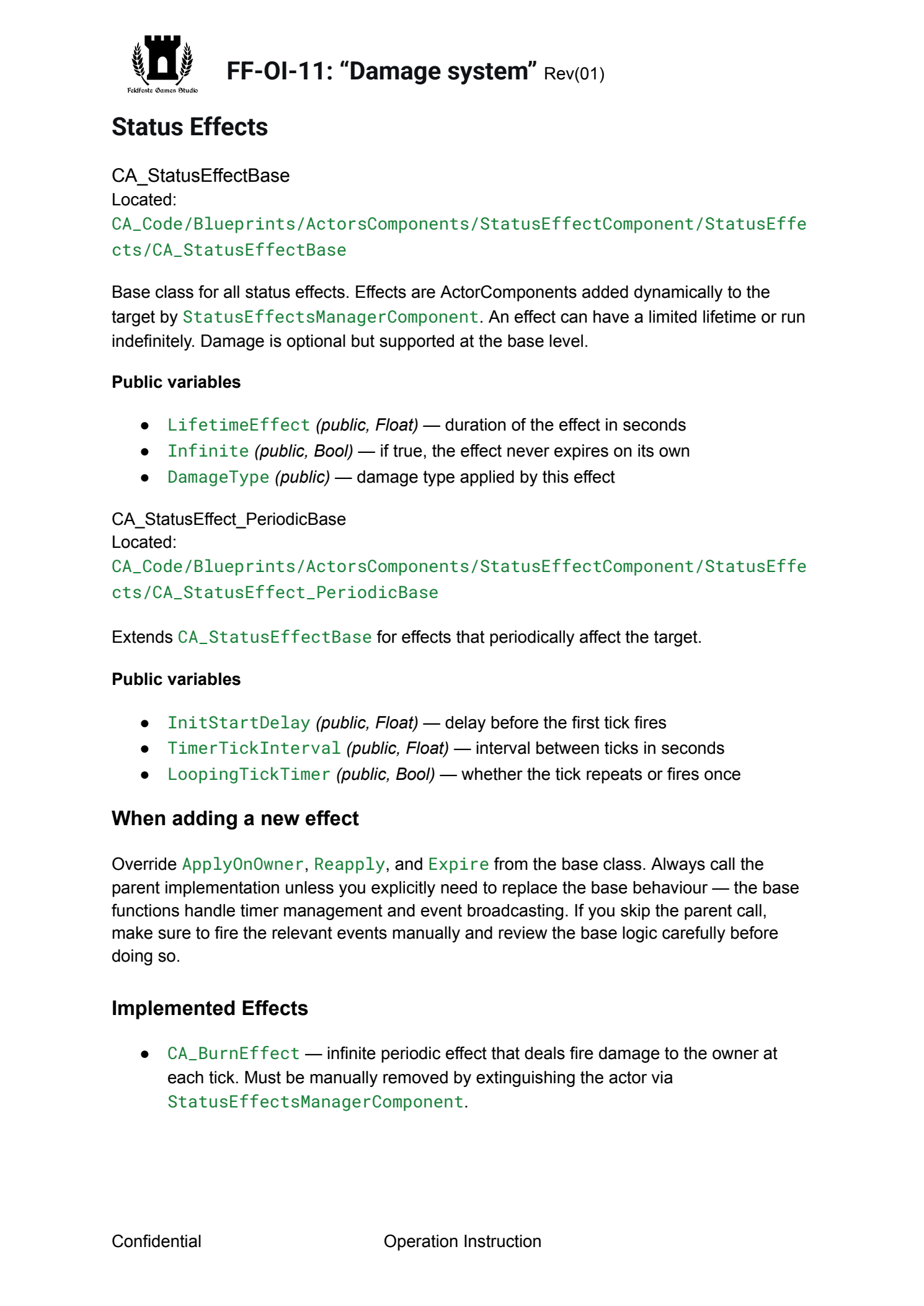
Status  Effects
CA_StatusEffectBase
Located:
 CA_Code/Blueprints/ActorsComponents/StatusEffectComponent/StatusEffe
cts/CA_StatusEffectBase

Base  class  for  all  status  effects.  Effects  are  ActorComponents  added  dynamically  to  the
target

by
 StatusEffectsManagerComponent.  An  effect  can  have  a  limited  lifetime  or  run
indefinitely.

Damage

is

optional

but

supported

at

the

base

level.

Public  variables
●  LifetimeEffect (public,  Float)  —  duration  of  the  effect  in  seconds  ●  Infinite (public,  Bool)  —  if  true,  the  effect  never  expires  on  its  own  ●  DamageType (public)  —  damage  type  applied  by  this  effect
CA_StatusEffect_PeriodicBase
Located:
 CA_Code/Blueprints/ActorsComponents/StatusEffectComponent/StatusEffe
cts/CA_StatusEffect_PeriodicBase

Extends  CA_StatusEffectBase for  effects  that  periodically  affect  the  target.
Public  variables
●  InitStartDelay (public,  Float)  —  delay  before  the  first  tick  fires  ●  TimerTickInterval (public,  Float)  —  interval  between  ticks  in  seconds  ●  LoopingTickTimer (public,  Bool)  —  whether  the  tick  repeats  or  fires  once
When  adding  a  new  effect
Override  ApplyOnOwner,  Reapply,  and  Expire from  the  base  class.  Always  call  the
parent

implementation

unless

you

explicitly

need

to

replace

the

base

behaviour

—

the

base

functions

handle

timer

management

and

event

broadcasting.

If

you

skip

the

parent

call,

make

sure

to

fire

the

relevant

events

manually

and

review

the

base

logic

carefully

before

doing

so.


Implemented  Effects
●  CA_BurnEffect —  infinite  periodic  effect  that  deals  fire  damage  to  the  owner  at
each

tick.

Must

be

manually

removed

by

extinguishing

the

actor

via
 StatusEffectsManagerComponent.

Confidential  Operation  Instruction
Page 10
Text for copying and search
FF-OI-11:  “Damage  system”
Rev(01)

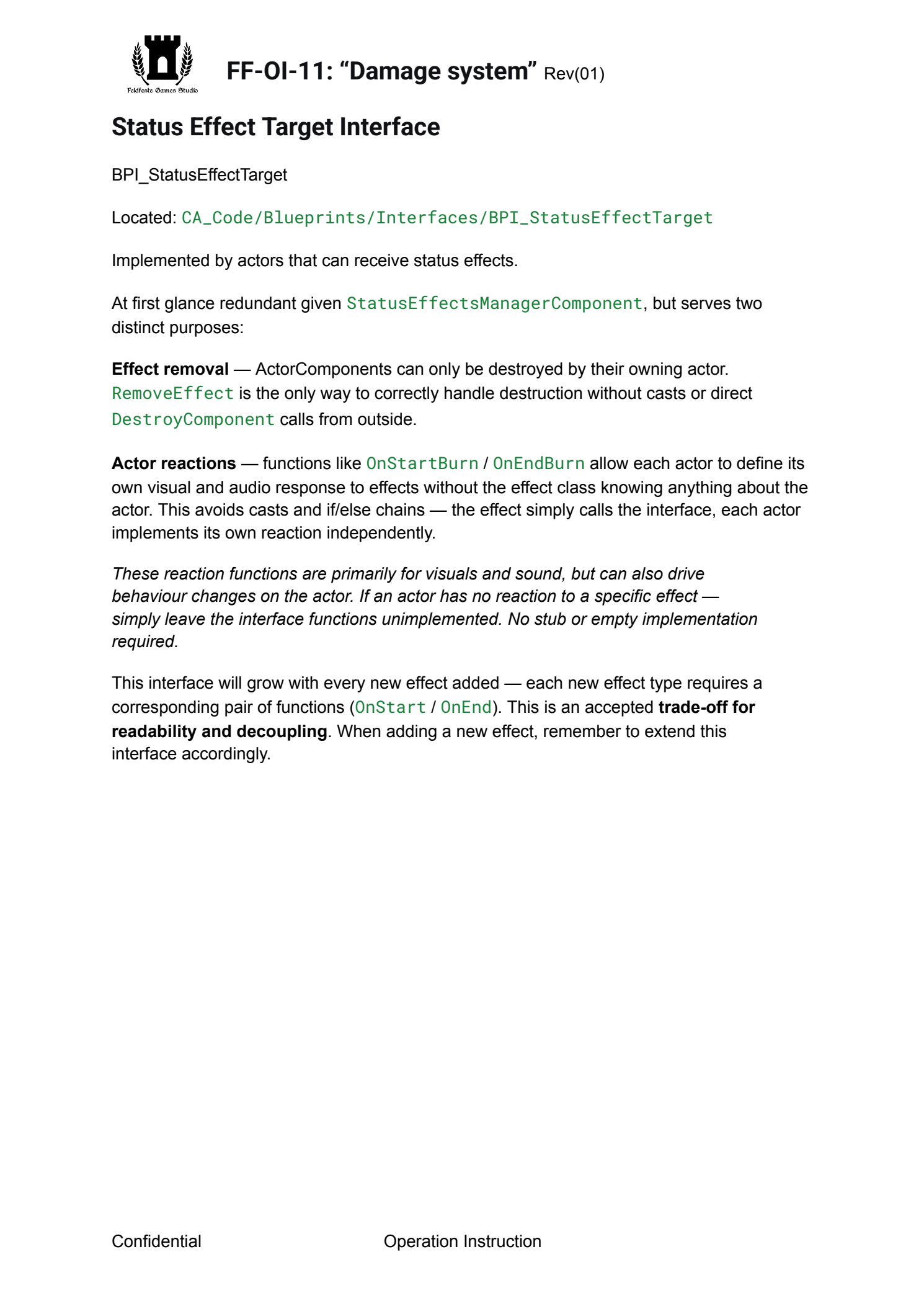
Status  Effect  Target  Interface
BPI_StatusEffectTarget
Located:  CA_Code/Blueprints/Interfaces/BPI_StatusEffectTarget
Implemented  by  actors  that  can  receive  status  effects.
At  first  glance  redundant  given  StatusEffectsManagerComponent,  but  serves  two
distinct

purposes:

Effect  removal  —  ActorComponents  can  only  be  destroyed  by  their  owning  actor.  RemoveEffect is  the  only  way  to  correctly  handle  destruction  without  casts  or  direct  DestroyComponent calls  from  outside.
Actor  reactions  —  functions  like  OnStartBurn /  OnEndBurn allow  each  actor  to  define  its
own

visual

and

audio

response

to

effects

without

the

effect

class

knowing

anything

about

the

actor.

This

avoids

casts

and

if/else

chains

—

the

effect

simply

calls

the

interface,

each

actor

implements

its

own

reaction

independently.

These  reaction  functions  are  primarily  for  visuals  and  sound,  but  can  also  drive
behaviour

changes

on

the

actor.

If

an

actor

has

no

reaction

to

a

specific

effect

—

simply

leave

the

interface

functions

unimplemented.

No

stub

or

empty

implementation

required.


This  interface  will  grow  with  every  new  effect  added  —  each  new  effect  type  requires  a
corresponding

pair

of

functions

(OnStart /  OnEnd).  This  is  an  accepted  trade-off  for
readability

and

decoupling
.

When

adding

a

new

effect,

remember

to

extend

this

interface

accordingly.


Confidential  Operation  Instruction
Page 11
Text for copying and search
FF-OI-11:  “Damage  system”
Rev(01)

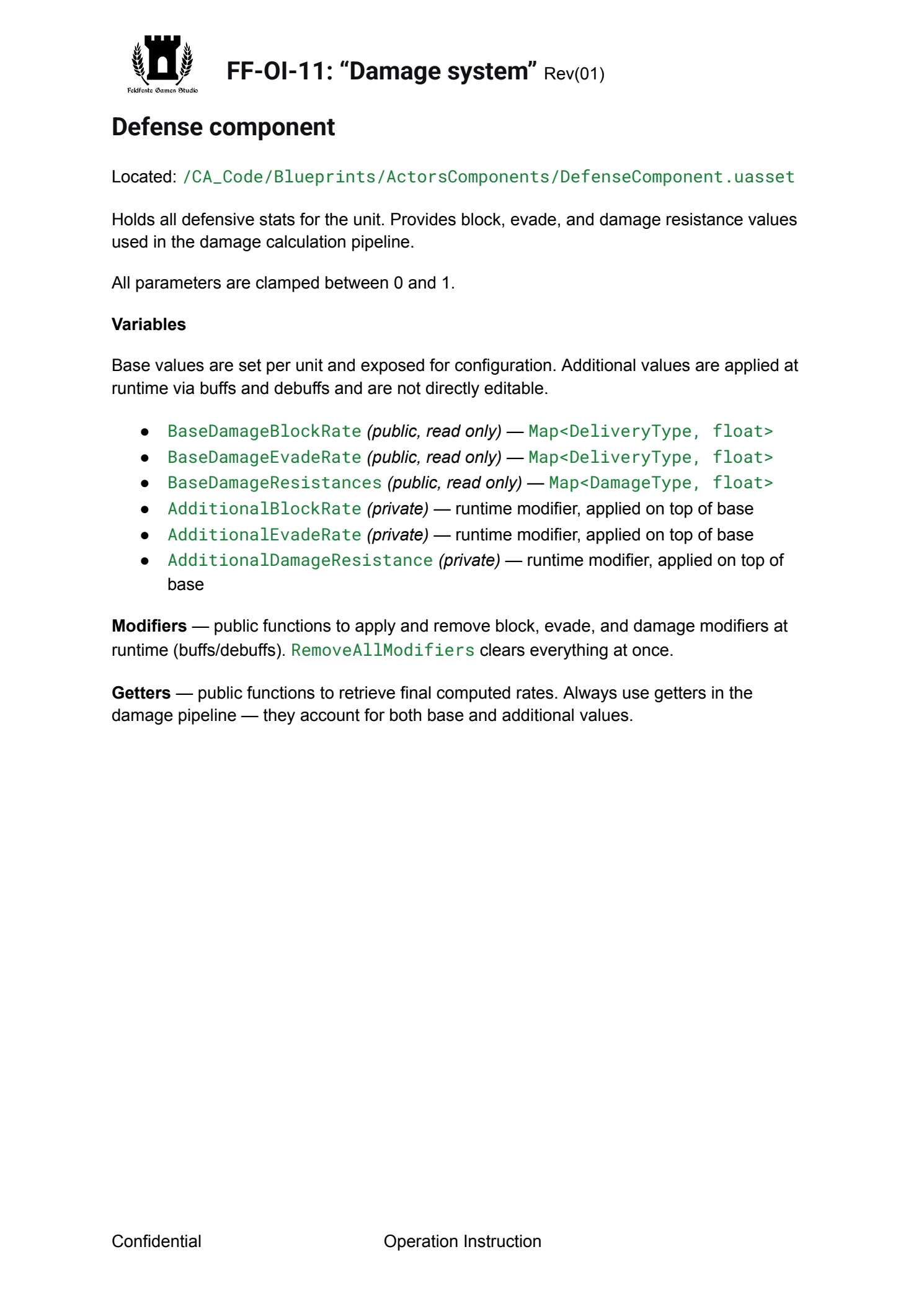
Defense  component
Located:  /CA_Code/Blueprints/ActorsComponents/DefenseComponent.uasset
Holds  all  defensive  stats  for  the  unit.  Provides  block,  evade,  and  damage  resistance  values
used

in

the

damage

calculation

pipeline.

All  parameters  are  clamped  between  0  and  1.
Variables
Base  values  are  set  per  unit  and  exposed  for  configuration.  Additional  values  are  applied  at
runtime

via

buffs

and

debuffs

and

are

not

directly

editable.

●  BaseDamageBlockRate (public,  read  only)  —  Map<DeliveryType,  float>  ●  BaseDamageEvadeRate (public,  read  only)  —  Map<DeliveryType,  float>  ●  BaseDamageResistances (public,  read  only)  —  Map<DamageType,  float>  ●  AdditionalBlockRate (private)  —  runtime  modifier,  applied  on  top  of  base  ●  AdditionalEvadeRate (private)  —  runtime  modifier,  applied  on  top  of  base  ●  AdditionalDamageResistance (private)  —  runtime  modifier,  applied  on  top  of
base

Modifiers  —  public  functions  to  apply  and  remove  block,  evade,  and  damage  modifiers  at
runtime

(buffs/debuffs).
 RemoveAllModifiers clears  everything  at  once.
Getters  —  public  functions  to  retrieve  final  computed  rates.  Always  use  getters  in  the
damage

pipeline

—

they

account

for

both

base

and

additional

values.


Confidential  Operation  Instruction
Page 12
Text for copying and search
FF-OI-11:  “Damage  system”
Rev(01)

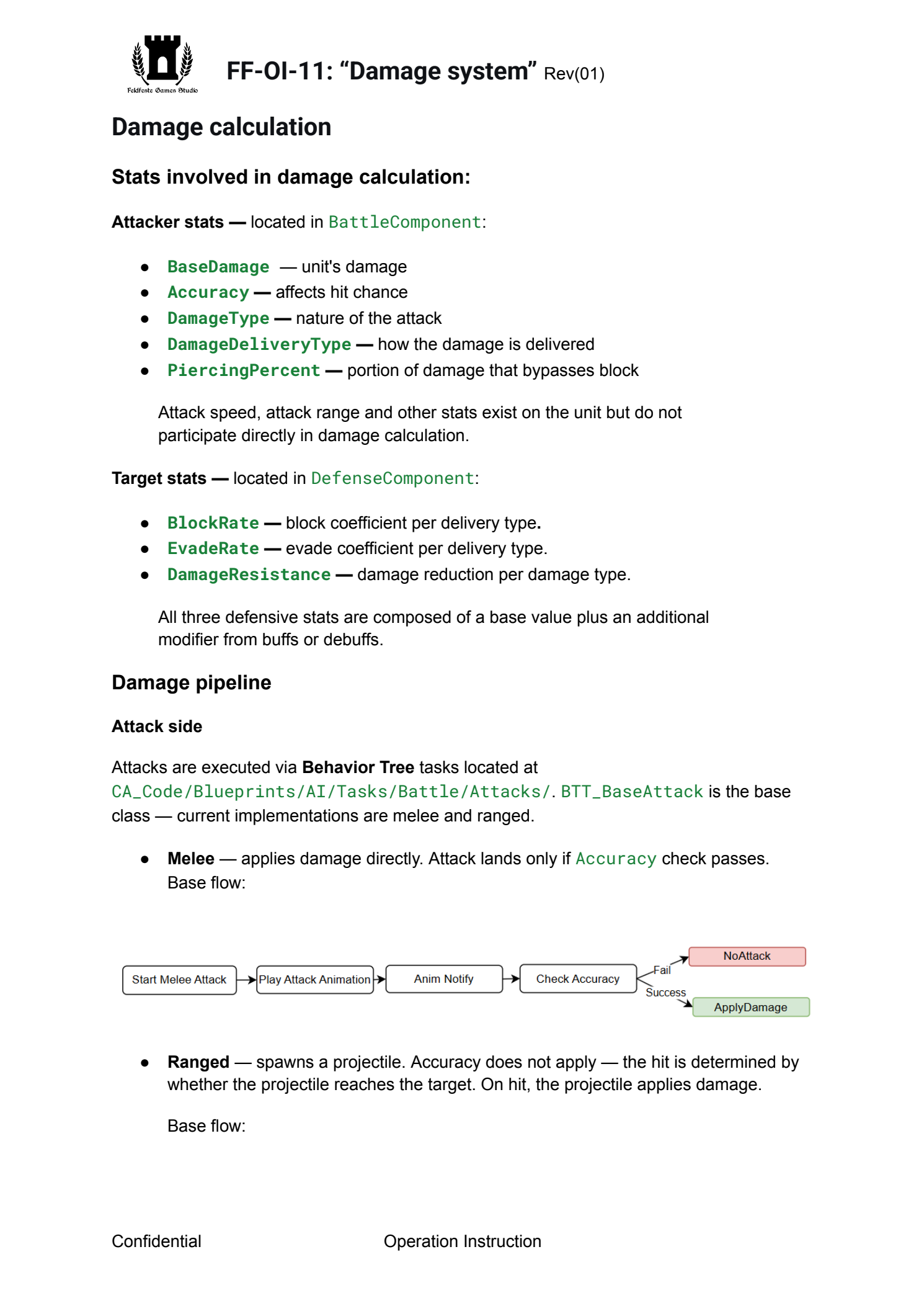
Damage  calculation
Stats  involved  in  damage  calculation:
Attacker  stats  —  located  in  BattleComponent:
●  BaseDamage  —  unit's  damage   ●  Accuracy —  affects  hit  chance  ●  DamageType —  nature  of  the  attack  ●  DamageDeliveryType —  how  the  damage  is  delivered  ●  PiercingPercent —  portion  of  damage  that  bypasses  block
Attack  speed,  attack  range  and  other  stats  exist  on  the  unit  but  do  not
participate

directly

in

damage

calculation.

Target  stats  —  located  in  DefenseComponent:
●  BlockRate —  block  coefficient  per  delivery  type .  ●  EvadeRate —  evade  coefficient  per  delivery  type.   ●  DamageResistance —  damage  reduction  per  damage  type.
All  three  defensive  stats  are  composed  of  a  base  value  plus  an  additional
modifier

from

buffs

or

debuffs.

Damage  pipeline
Attack  side
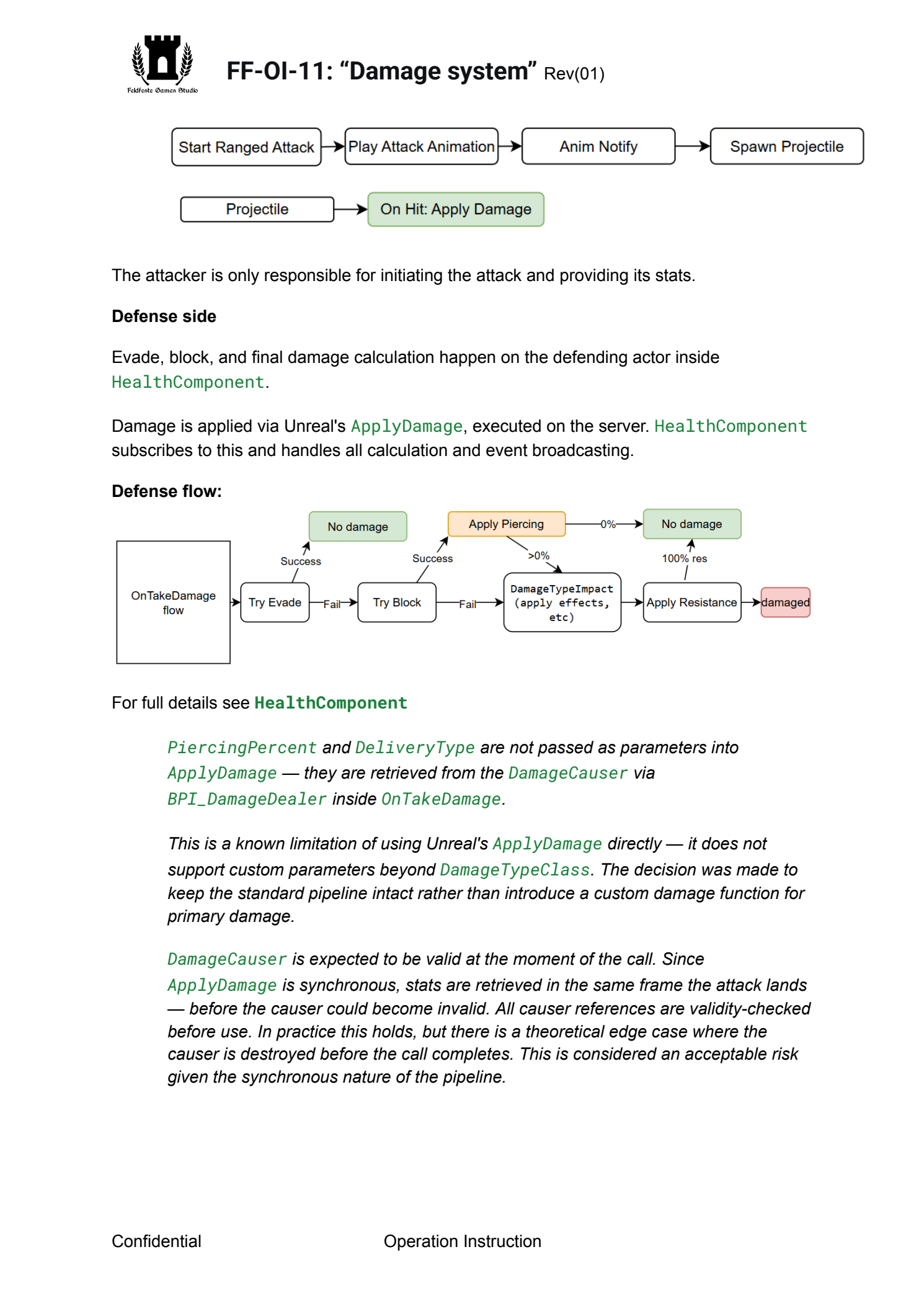
Attacks  are  executed  via  Behavior  Tree  tasks  located  at  CA_Code/Blueprints/AI/Tasks/Battle/Attacks/.  BTT_BaseAttack is  the  base
class

—

current

implementations

are

melee

and

ranged.

●  Melee  —  applies  damage  directly.  Attack  lands  only  if  Accuracy check  passes.
Base

flow:


●  Ranged  —  spawns  a  projectile.  Accuracy  does  not  apply  —  the  hit  is  determined  by
whether

the

projectile

reaches

the

target.

On

hit,

the

projectile

applies

damage.

Base  flow:
Confidential  Operation  Instruction
Page 13
Text for copying and search
FF-OI-11:  “Damage  system”
Rev(01)


The  attacker  is  only  responsible  for  initiating  the  attack  and  providing  its  stats.
Defense  side
Evade,  block,  and  final  damage  calculation  happen  on  the  defending  actor  inside  HealthComponent.
Damage  is  applied  via  Unreal's  ApplyDamage,  executed  on  the  server.  HealthComponent
subscribes

to

this

and

handles

all

calculation

and

event

broadcasting.

Defense  flow:

For  full  details  see  HealthComponent
PiercingPercent and  DeliveryType are  not  passed  as  parameters  into  ApplyDamage —  they  are  retrieved  from  the  DamageCauser via  BPI_DamageDealer inside  OnTakeDamage.
This  is  a  known  limitation  of  using  Unreal's  ApplyDamage directly  —  it  does  not
support

custom

parameters

beyond
 DamageTypeClass.  The  decision  was  made  to
keep

the

standard

pipeline

intact

rather

than

introduce

a

custom

damage

function

for

primary

damage.

DamageCauser is  expected  to  be  valid  at  the  moment  of  the  call.  Since  ApplyDamage is  synchronous,  stats  are  retrieved  in  the  same  frame  the  attack  lands
—

before

the

causer

could

become

invalid.

All

causer

references

are

validity-checked

before

use.

In

practice

this

holds,

but

there

is

a

theoretical

edge

case

where

the

causer

is

destroyed

before

the

call

completes.

This

is

considered

an

acceptable

risk

given

the

synchronous

nature

of

the

pipeline.

Confidential  Operation  Instruction
Page 14
Text for copying and search
FF-OI-11:  “Damage  system”
Rev(01)

Effect  Damage
Status  effects  deal  damage  through  a  separate  server  event  ApplyEffectDamage in  HealthComponent,  bypassing  the  main  OnTakeDamage pipeline.  This  avoids  an  effect
reapplying

itself

on

each

damage

tick.

Effect  damage  cannot  be  evaded  or  blocked  —  only  DamageResistance is  applied  before
dealing

the

final

damage.


Confidential  Operation  Instruction
Page 15
Text for copying and search
FF-OI-11:  “Damage  system”
Rev(01)

Kinetic  impact
This  section  is  under  development.
Confidential  Operation  Instruction
Page 16
Text for copying and search
FF-OI-11:  “Damage  system”
Rev(01)

Attack  speed  This  section  is  under  development.
Confidential  Operation  Instruction
Page 17
Text for copying and search
FF-OI-11:  “Damage  system”
Rev(01)

Anim  notify   This  section  is  under  development.
Confidential  Operation  Instruction