Download original PDF · Plain-text extract
Every original page is reproduced below, including all illustrations, tables and labels. Select a page image to open it at full resolution. Expand Text for copying and search below a page to read its extracted text; extraction may change spacing or special characters.
Page 1
Text for copying and search
FF-OI-17:  “Attribute  Components”
Rev(01)

Feldfeste  Operation  Instruction
 FF-OI-17:  “Attribute  Components”   Document  History   Revision  Content  Editor  Time  01  Initial  Document  Creation  Arina  10.09.2026
Confidential  Operation  Instruction
Page 2
Text for copying and search
FF-OI-17:  “Attribute  Components”
Rev(01)


Table  of  Contents  Overview .................................................................................................................................. 3 Base  Attribute  Component ....................................................................................................... 4 Functions ............................................................................................................................ 4 Variables ............................................................................................................................. 5 Event  Dispatchers .............................................................................................................. 5 Adding  a  new  attribute ........................................................................................................ 5 Health  Component ................................................................................................................... 6 Functions ............................................................................................................................ 6 Variables ............................................................................................................................. 6 Events ................................................................................................................................ 7 Stability  Component ................................................................................................................. 8 Functions ............................................................................................................................ 8 Variables ............................................................................................................................. 8 Events ................................................................................................................................ 8 Experience  Component ............................................................................................................ 9 Adding  experience .............................................................................................................. 9 New  level  formula ............................................................................................................. 10 Functions .......................................................................................................................... 10 Variables ........................................................................................................................... 11 Events ............................................................................................................................... 11 Morale  Component ................................................................................................................. 12 Changing  morale .............................................................................................................. 12 Design  note ...................................................................................................................... 12 Functions .......................................................................................................................... 12 Variables ........................................................................................................................... 12 Events .............................................................................................................................. 13 Stamina  Component .............................................................................................................. 14 Functions .......................................................................................................................... 14 Variables ........................................................................................................................... 14 Events .............................................................................................................................. 14

Confidential  Operation  Instruction
Page 3
Text for copying and search
FF-OI-17:  “Attribute  Components”
Rev(01)

Overview
This  document  describes  the  attribute  system  architecture.  The  system  is  built  around  a
single

reusable

base

component

that

encapsulates

one

float

value

—

designed

so

that

adding

a

new

attribute

(health,

stamina,

experience,

etc.)

requires

no

duplication

of

core

logic.


This  document  covers  BaseAttributeComponent  and  its  child  components.
Key  Concepts
●  BaseAttributeComponent  —  parent  class  storing  and  managing  a  single  float
attribute;

provides

init,

value

access,

and

optional

regeneration
 ●  HealthComponent  —  health,  with  restore  and  damage  handling;  dies  at  0  ●  StabilityComponent  —  health  for  buildings;  can  be  restored  at  0  HP,  cannot  evade
or

block

damage
 ●  ExperienceComponent  —  experience  and  level  progression,  with  optional  manual
level-up
 ●  MoraleComponent  —  morale  that  can  influence  actor  behaviour;  regenerates
toward

a

configurable

baseline

instead

of

max
 ●  StaminaComponent  —  stamina  spent  on  actions  and  restored  by  resting
As  a  general  rule,  attribute  components  are  only  responsible  for  storing  and  managing  their
own

value

—

not

for

deciding

why

it

should

change

or

what

triggers

that

change.

That

decision

belongs

to

other

systems

that

call

into

them.


Confidential  Operation  Instruction
Page 4
Text for copying and search
FF-OI-17:  “Attribute  Components”
Rev(01)

Base  Attribute  Component
Base  class  located:  /CA_Code/Blueprints/ActorsComponents/AttributeComponents/BaseAttribu
teComponent.uasset
 Base  component  that  stores  and  manages  a  single  float  value  with  encapsulated  access.
Designed

to

be

reused

for

any

float-based

attribute

on

an

actor

—

health,

stamina,

experience,

etc.

  BaseAttributeComponent  is  an  abstract  class  —  it  cannot  be  added  directly  to  an  actor
and

only

exists

to

be

extended

by

child

components.


Functions
Grouped  into  three  categories:  Attribute  Default ,  Attribute ,  and  Regeneration .
●  Attribute  Default  —  handles  initialization:  setting  the  starting  max  value,  running  init
logic,

and

checking

whether

initialization

has

completed.
 ●  Attribute  —  core  read/write  logic  for  the  value:  setting,  updating,  and  clamping  it,
plus

getters

for

current

value,

max

value,

percent,

and

full/zero

state.
 ●  Regeneration  —  controls  automatic  value  recovery  over  time:  starting,  stopping,  and
ticking

regeneration,

checking

whether

it

can

run,

and

configuring

its

rate

and

delay.

Most  functions  are  protected  —  intended  to  be  called  by  this  component  and  its  child
classes.

Only

functions

meant

to

be

used

externally

(e.g.

by

other

systems

querying

the

attribute)

are

public
.

⚠  When  overriding  these  functions  in  a  child  class,  make  sure  to  keep  calling  any
relevant

events

that

were

present

in

the

base

implementation

—

skipping

them

can

silently

break

dependent

systems

(UI,

other

components)

that

rely

on

those

broadcasts.


Value  Setters
The  component  exposes  three  layered  functions  for  changing  the  attribute's  value,  each
building

on

the

one

below

it.

●  UpdateValue  (protected)  —  the  base  function  for  changing  the  attribute  by  a  delta.
Takes

a
 Delta value,  clears  and  restarts  the  auto-regeneration  timer  (if  regeneration
is

enabled),

then

calls

SetValue

internally.
 ○  Restarting  the  timer  ensures  regeneration  doesn't  resume  mid-cycle  after  an
interruption

—

e.g.

if

the

character

takes

damage,

the

timer

resets

and

the

initial

regeneration

delay

starts

over,

rather

than

continuing

as

if

nothing

happened.
 ●  SetValue  (protected)  —  sets  the  attribute  to  an  exact  new  value.  Calls
SetValueSilent

internally,

then

broadcasts

OnAttributeValueChanged
.
 ○  Used  directly  by  the  regeneration  tick  (instead  of  UpdateValue),  since
UpdateValue

would

reset

the

regeneration

timer

on

every

tick.

Confidential  Operation  Instruction
Page 5
Text for copying and search
FF-OI-17:  “Attribute  Components”
Rev(01)

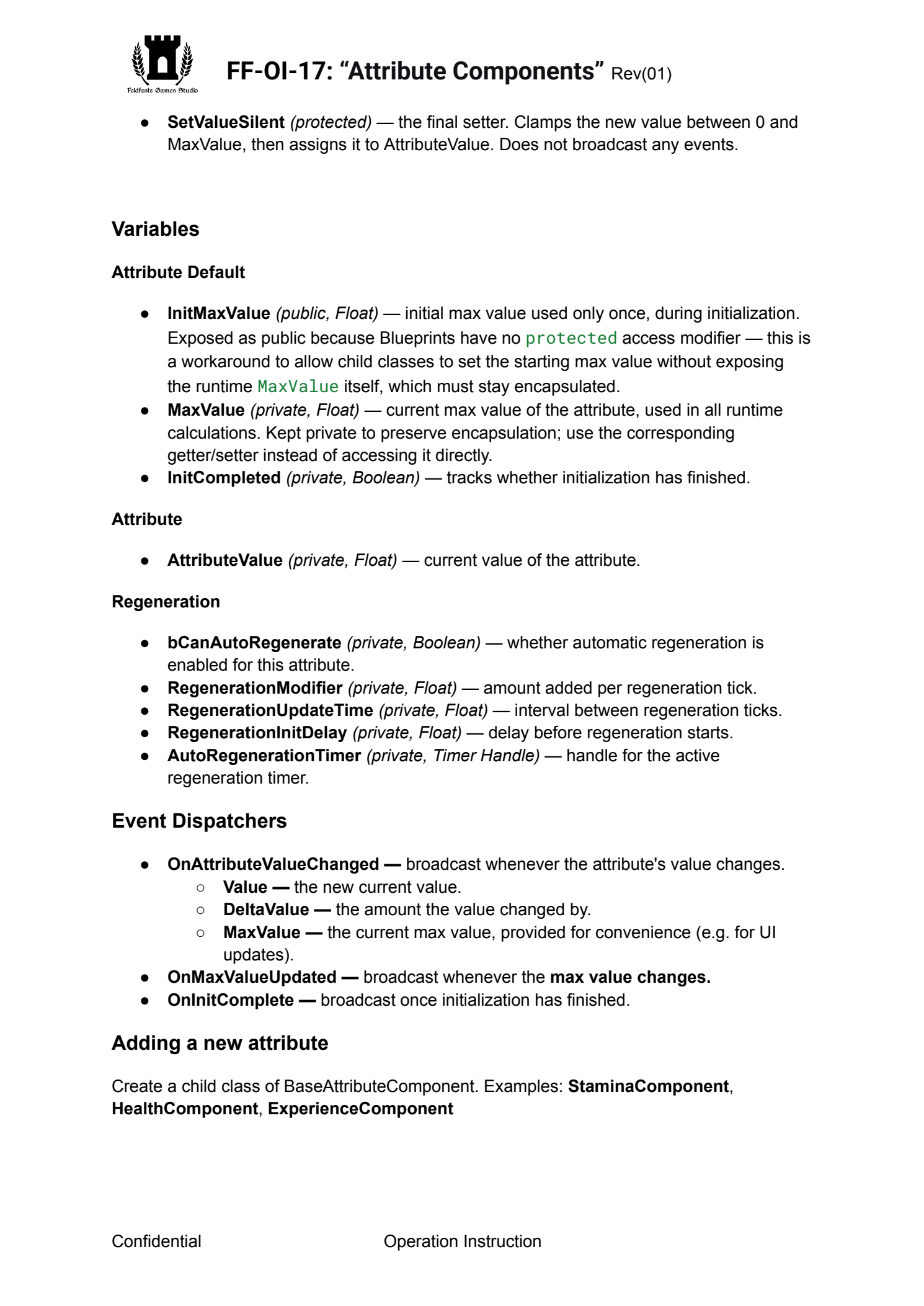
●  SetValueSilent  (protected)  —  the  final  setter.  Clamps  the  new  value  between  0  and
MaxValue,

then

assigns

it

to

AttributeValue.

Does

not

broadcast

any

events.


Variables
Attribute  Default
●  InitMaxValue  (public,  Float)  —  initial  max  value  used  only  once,  during  initialization.
Exposed

as

public

because

Blueprints

have

no
 protected access  modifier  —  this  is
a

workaround

to

allow

child

classes

to

set

the

starting

max

value

without

exposing

the

runtime
 MaxValue itself,  which  must  stay  encapsulated.  ●  MaxValue  (private,  Float)  —  current  max  value  of  the  attribute,  used  in  all  runtime
calculations.

Kept

private

to

preserve

encapsulation;

use

the

corresponding

getter/setter

instead

of

accessing

it

directly.

 ●  InitCompleted  (private,  Boolean)  —  tracks  whether  initialization  has  finished.
Attribute
●  AttributeValue  (private,  Float)  —  current  value  of  the  attribute.
Regeneration
●  bCanAutoRegenerate  (private,  Boolean)  —  whether  automatic  regeneration  is
enabled

for

this

attribute.
 ●  RegenerationModifier  (private,  Float)  —  amount  added  per  regeneration  tick.  ●  RegenerationUpdateTime  (private,  Float)  —  interval  between  regeneration  ticks.  ●  RegenerationInitDelay  (private,  Float)  —  delay  before  regeneration  starts.  ●  AutoRegenerationTimer  (private,  Timer  Handle)  —  handle  for  the  active
regeneration

timer.

Event  Dispatchers
●  OnAttributeValueChanged  —  broadcast  whenever  the  attribute's  value  changes.  ○  Value  —  the  new  current  value.  ○  DeltaValue  —  the  amount  the  value  changed  by.  ○  MaxValue  —  the  current  max  value,  provided  for  convenience  (e.g.  for  UI
updates).
 ●  OnMaxValueUpdated  —  broadcast  whenever  the  max  value  changes.  ●  OnInitComplete  —  broadcast  once  initialization  has  finished.
Adding  a  new  attribute
Create  a  child  class  of  BaseAttributeComponent.  Examples:  StaminaComponent ,
HealthComponent
,

ExperienceComponent

Confidential  Operation  Instruction
Page 6
Text for copying and search
FF-OI-17:  “Attribute  Components”
Rev(01)

Health  Component
Located:  /CA_Code/Blueprints/ActorsComponents/AttributeComponents/HealthCompo
nent.uasset
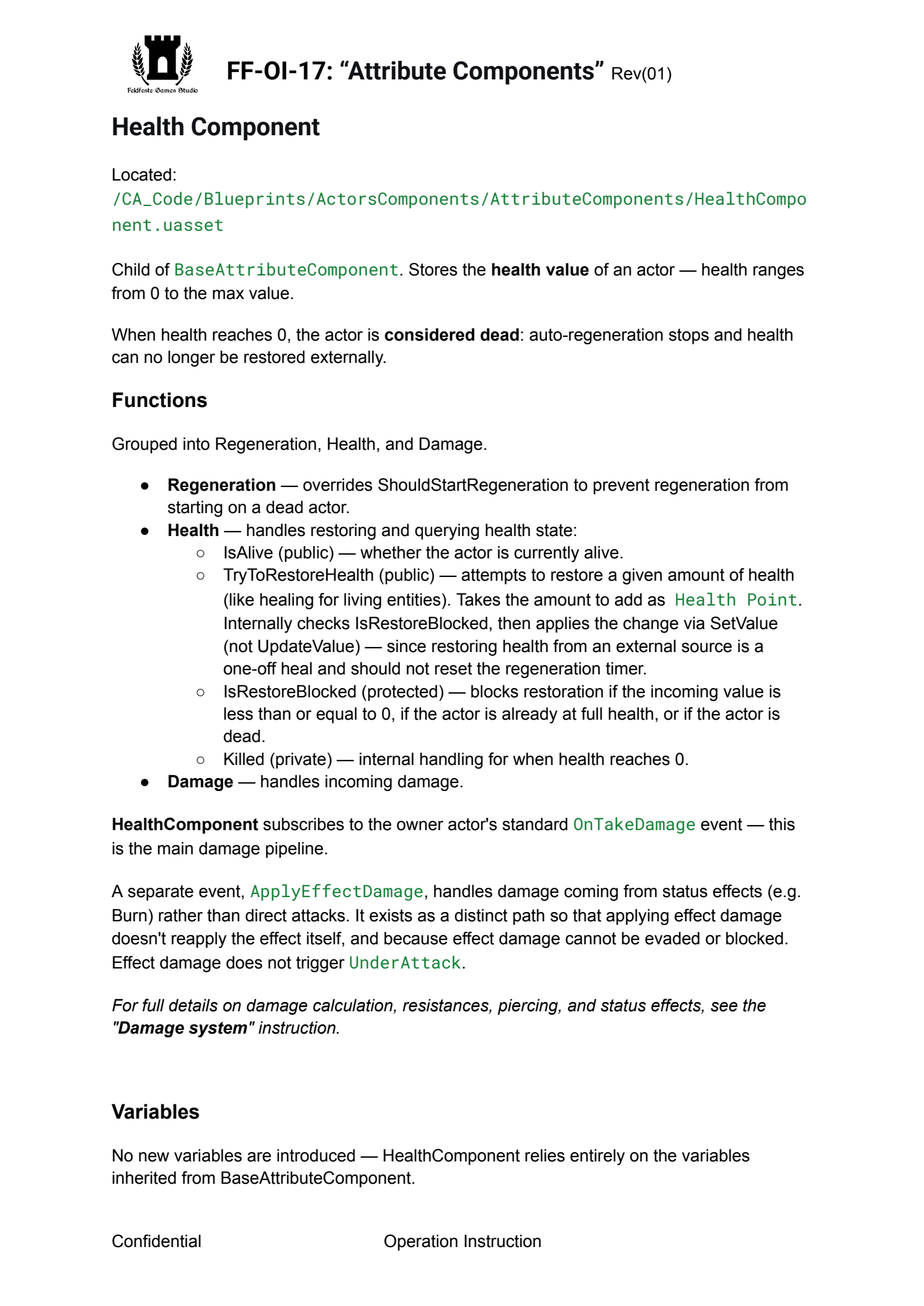
Child  of  BaseAttributeComponent.  Stores  the  health  value  of  an  actor  —  health  ranges
from

0

to

the

max

value.


When  health  reaches  0,  the  actor  is  considered  dead :  auto-regeneration  stops  and  health
can

no

longer

be

restored

externally.

Functions
Grouped  into  Regeneration,  Health,  and  Damage.
●  Regeneration  —  overrides  ShouldStartRegeneration  to  prevent  regeneration  from
starting

on

a

dead

actor.
 ●  Health  —  handles  restoring  and  querying  health  state:  ○  IsAlive  (public)  —  whether  the  actor  is  currently  alive.  ○  TryToRestoreHealth  (public)  —  attempts  to  restore  a  given  amount  of  health
(like

healing

for

living

entities).

Takes

the

amount

to

add

as
  Health  Point.
Internally

checks

IsRestoreBlocked,

then

applies

the

change

via

SetValue

(not

UpdateValue)

—

since

restoring

health

from

an

external

source

is

a

one-off

heal

and

should

not

reset

the

regeneration

timer.
 ○  IsRestoreBlocked  (protected)  —  blocks  restoration  if  the  incoming  value  is
less

than

or

equal

to

0,

if

the

actor

is

already

at

full

health,

or

if

the

actor

is

dead.
 ○  Killed  (private)  —  internal  handling  for  when  health  reaches  0.  ●  Damage  —  handles  incoming  damage.
HealthComponent  subscribes  to  the  owner  actor's  standard  OnTakeDamage event  —  this
is

the

main

damage

pipeline.

A  separate  event,  ApplyEffectDamage,  handles  damage  coming  from  status  effects  (e.g.
Burn)

rather

than

direct

attacks.

It

exists

as

a

distinct

path

so

that

applying

effect

damage

doesn't

reapply

the

effect

itself,

and

because

effect

damage

cannot

be

evaded

or

blocked.

Effect

damage

does

not

trigger
 UnderAttack.
For  full  details  on  damage  calculation,  resistances,  piercing,  and  status  effects,  see  the
"
Damage

system
"

instruction.


Variables
No  new  variables  are  introduced  —  HealthComponent  relies  entirely  on  the  variables
inherited

from

BaseAttributeComponent.

Confidential  Operation  Instruction
Page 7
Text for copying and search
FF-OI-17:  “Attribute  Components”
Rev(01)

Events
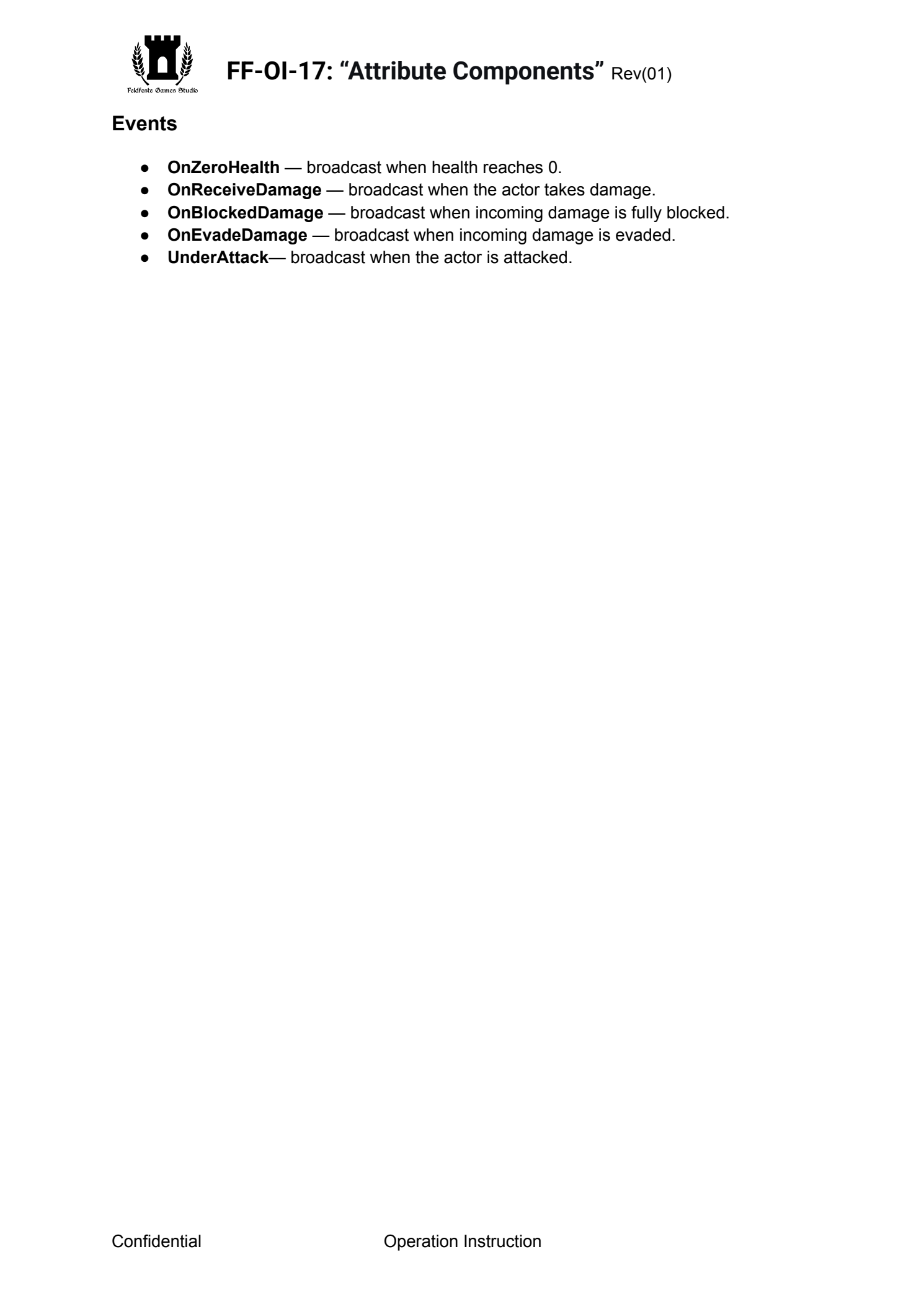
●  OnZeroHealth  —  broadcast  when  health  reaches  0.  ●  OnReceiveDamage  —  broadcast  when  the  actor  takes  damage.  ●  OnBlockedDamage  —  broadcast  when  incoming  damage  is  fully  blocked.  ●  OnEvadeDamage  —  broadcast  when  incoming  damage  is  evaded.  ●  UnderAttack —  broadcast  when  the  actor  is  attacked.

Confidential  Operation  Instruction
Page 8
Text for copying and search
FF-OI-17:  “Attribute  Components”
Rev(01)

Stability  Component
Located:  CA_Code/Blueprints/ActorsComponents/AttributeComponents/StabilityCom
ponent.uasset
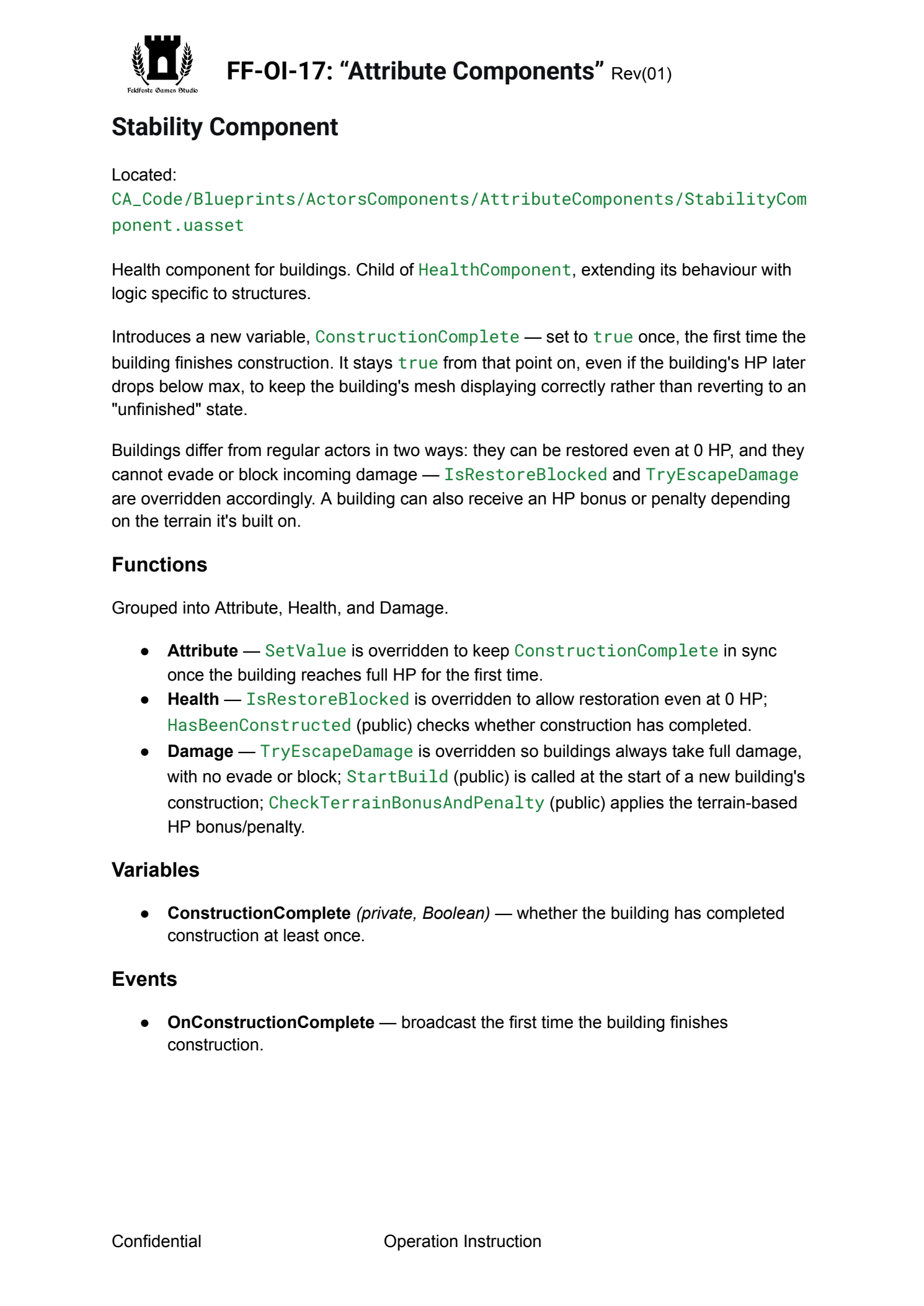
Health  component  for  buildings.  Child  of  HealthComponent,  extending  its  behaviour  with
logic

specific

to

structures.

Introduces  a  new  variable,  ConstructionComplete —  set  to  true once,  the  first  time  the
building

finishes

construction.

It

stays
 true from  that  point  on,  even  if  the  building's  HP  later
drops

below

max,

to

keep

the

building's

mesh

displaying

correctly

rather

than

reverting

to

an

"unfinished"

state.

Buildings  differ  from  regular  actors  in  two  ways:  they  can  be  restored  even  at  0  HP,  and  they
cannot

evade

or

block

incoming

damage

—
 IsRestoreBlocked and  TryEscapeDamage
are

overridden

accordingly.

A

building

can

also

receive

an

HP

bonus

or

penalty

depending

on

the

terrain

it's

built

on.

Functions
Grouped  into  Attribute,  Health,  and  Damage.
●  Attribute  —  SetValue is  overridden  to  keep  ConstructionComplete in  sync
once

the

building

reaches

full

HP

for

the

first

time.
 ●  Health  —  IsRestoreBlocked is  overridden  to  allow  restoration  even  at  0  HP;  HasBeenConstructed (public)  checks  whether  construction  has  completed.  ●  Damage  —  TryEscapeDamage is  overridden  so  buildings  always  take  full  damage,
with

no

evade

or

block;
 StartBuild (public)  is  called  at  the  start  of  a  new  building's
construction;
 CheckTerrainBonusAndPenalty (public)  applies  the  terrain-based
HP

bonus/penalty.

Variables
●  ConstructionComplete  (private,  Boolean)  —  whether  the  building  has  completed
construction

at

least

once.

Events
●  OnConstructionComplete  —  broadcast  the  first  time  the  building  finishes
construction.


Confidential  Operation  Instruction
Page 9
Text for copying and search
FF-OI-17:  “Attribute  Components”
Rev(01)

Experience  Component
Located:  CA_Code/Blueprints/ActorsComponents/AttributeComponents/ExperienceCo
mponent.uasset
Child  of  BaseAttributeComponent.  One  of  the  more  complex  attributes  —  introduces
several

new

concepts:

●  The  inherited  BaseAttributeComponent value  holds  the  unit's  committed
experience

—

experience

toward

the

current

level.
 ●  Level (integer)  —  has  a  current,  max,  and  start  value.  The  minimum  possible  level
is

1.
 ●  AccumulatedExp —  a  separate  buffer  for  experience  the  unit  has  earned  but  not
yet

committed.

Not

to

be

confused

with

committed

experience

above

—

this

value

only

exists

to

be

committed

later.

Adding  experience
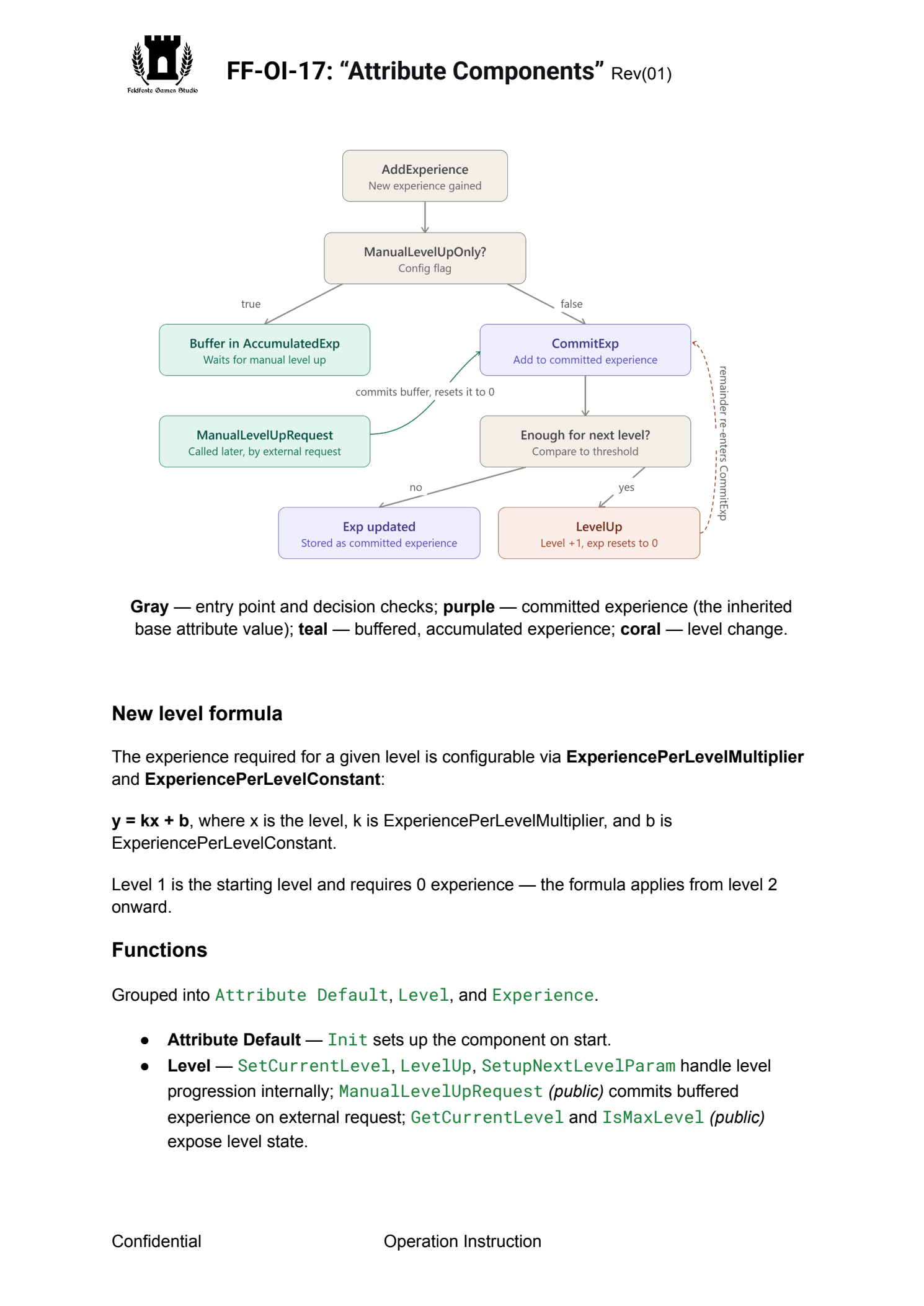
New  experience  is  added  through  AddExperience.  Behaviour  depends  on  the  ManualLevelUpOnly setting:
●  If  true ,  incoming  experience  is  first  buffered  into  AccumulatedExp.  It  only  gets
committed

—

and

can

trigger

a

level

up

—

on

an

external

request

(ManualLevelUpRequest),  which  commits  the  buffer  via  CommitExp and  resets  AccumulatedExp to  0.
This  lets  gameplay  defer  level-ups  to  a  moment  outside  combat:  e.g.  a  unit  earns
experience

mid-fight,

but

only

actually

levels

up

once

it

returns

to

camp

and

rests.

●  If  false ,  experience  is  committed  immediately.
Committing  experience  (CommitExp)  adds  it  to  the  committed  experience  value.  If  the  total
reaches

the

threshold

required

for

the

next

level,

the

unit

levels

up

(LevelUp),  committed
experience

resets

to

0,

and

any

leftover

experience

is

recommitted

—

so

a

large

enough

gain

can

trigger

multiple

level-ups

in

a

row.


Confidential  Operation  Instruction
Page 10
Text for copying and search
FF-OI-17:  “Attribute  Components”
Rev(01)

Gray  —  entry  point  and  decision  checks;  purple  —  committed  experience  (the  inherited
base

attribute

value);

teal

—

buffered,

accumulated

experience;

coral

—

level

change.


New  level  formula
The  experience  required  for  a  given  level  is  configurable  via  ExperiencePerLevelMultiplier
and

ExperiencePerLevelConstant
:

y  =  kx  +  b ,  where  x  is  the  level,  k  is  ExperiencePerLevelMultiplier,  and  b  is
ExperiencePerLevelConstant.

Level  1  is  the  starting  level  and  requires  0  experience  —  the  formula  applies  from  level  2
onward.

Functions
Grouped  into  Attribute  Default,  Level,  and  Experience.
●  Attribute  Default  —  Init sets  up  the  component  on  start.  ●  Level  —  SetCurrentLevel,  LevelUp,  SetupNextLevelParam handle  level
progression

internally;
 ManualLevelUpRequest (public)  commits  buffered
experience

on

external

request;
 GetCurrentLevel and  IsMaxLevel (public)
expose

level

state.

Confidential  Operation  Instruction
Page 11
Text for copying and search
FF-OI-17:  “Attribute  Components”
Rev(01)

●  Experience  —  SetExpForNextLevel,  CanAddExp,  SetAccumulatedExp,  CommitExp handle  the  internal  experience  flow;  GetExpRequiredForLevel,  HasEnoughExpToLevelUp,  GetExpRequiredForLevelUp,  GetCurrentExperience,  and  AddExperience (public)  expose  experience  state
and

the

main

entry

point

for

adding

experience.

Variables
Level
●  CurrentLVL  (private,  Integer)  —  current  level.
Experience
●  AccumulatedExp  (private,  Float)  —  buffered,  uncommitted  experience.  ●  ExperienceForNextLevel  (private,  Float)  —  cached  experience  threshold  for  the
current

level.

Experience  And  Level  Default
●  MaxLVL  (public,  Integer)  —  maximum  level.  ●  StartLVL  (public,  Integer)  —  starting  level.  ●  StartEXP  (public,  Float)  —  starting  experience.  ●  ManualLevelUpOnly  (public,  Boolean)  —  see  "Adding  experience"  above.  ●  ExperiencePerLevelMultiplier  (public,  Float)  —  used  in  the  threshold  formula.  ●  ExperiencePerLevelConstant  (public,  Float)  —  used  in  the  threshold  formula.

Events
●  OnLevelUp  —  broadcast  when  the  unit  levels  up.  ●  OnMaxLevel  —  broadcast  when  the  unit  reaches  max  level.  ●  OnNewExpForLevel  —  broadcast  when  the  threshold  for  the  next  level  is
recalculated.
 ●  OnAccumulatedExpChanged  —  broadcast  when  AccumulatedExp changes.


Confidential  Operation  Instruction
Page 12
Text for copying and search
FF-OI-17:  “Attribute  Components”
Rev(01)

Morale  Component
Located:  CA_Code/Blueprints/ActorsComponents/AttributeComponents/MoraleCompon
ent.uasset
Child  of  BaseAttributeComponent.  Stores  morale,  which  can  influence  the  behaviour  of
various

actors.

Introduces

one

new

concept:

●  Baseline  —  a  target  value  that  regeneration  always  pulls  morale  back  to,  moving  the
value

up

or

down

as

needed.

Unlike

other

attributes,

morale

doesn't

regenerate

toward

its

max

value

—

it

regenerates

toward

this

baseline

instead.

Most

of

the

component's

logic

exists

to

support

this

behaviour.

Changing  morale
●  ApplyMoraleEvent —  the  main  way  morale  changes.  Takes  a  MoraleEvent
enum;

the

actual

value

to

apply

is

looked

up

from

the
 DT_CA_MoraleEvents data
table

(CA_Code/DataTables/DT_CA_MoraleEvents.uasset).  ●  UpdateMorale —  a  public  function  to  change  morale  by  an  arbitrary  delta,  for  other
cases

not

covered

by

predefined

morale

events.

Design  note
 ⚠   The  Morale  Component  is  only  responsible  for  storing  and  regenerating  the  morale
value.

It

must

never

contain

logic

that

reacts

to

external

events

or

triggers

gameplay

side

effects

—

that

responsibility

belongs

to
 MoraleListenerComponent
(CA_Code/Blueprints/ActorsComponents/MoraleListenerComponent.uasset),
which

listens

for

requests

and

decides

when

and

how

morale

should

change.

Functions
●  Regeneration  —  overrides  the  base  regeneration  logic  so  the  value  moves  toward
the

baseline

each

tick,

instead

of

toward

max.
 ●  Baseline  —  restoring,  updating,  and  querying  the  current  baseline  value.
Most  functions  are  protected  —  intended  to  be  called  by  this  component  and  its  child
classes.


Only  functions  meant  to  be  used  externally  are  public.  UpdateMorale and  ApplyMoraleEvent,  described  above,  are  the  two  public  entry  points  for  changing  morale.
Variables
Regeneration
Confidential  Operation  Instruction
Page 13
Text for copying and search
FF-OI-17:  “Attribute  Components”
Rev(01)

●  DefaultRegenModifier  (public,  Float)  —  default  amount  the  value  moves  per
regeneration

tick.
 ●  DefaultRegenInitDelay  (public,  Float)  —  default  delay  before  regeneration  starts.  ●  DefaultRegenUpdateTime  (public,  Float)  —  default  interval  between  regeneration
ticks.

Morale
●  DefaultMoraleBaseline  (public,  Float)  —  the  baseline  value  morale  regenerates
toward,

by

default.

Baseline
●  MoraleBaseline  (private,  Float)  —  the  current  baseline  value,  which  regeneration
pulls

morale

toward.

Events
●  OnMoraleBaselineUpdated  —  broadcast  when  the  baseline  value  changes.


Confidential  Operation  Instruction
Page 14
Text for copying and search
FF-OI-17:  “Attribute  Components”
Rev(01)

Stamina  Component
Located:  CA_Code/Blueprints/ActorsComponents/AttributeComponents/StaminaCompo
nent.uasset

Child  of  BaseAttributeComponent.  Stores  stamina,  which  can  affect  various  actor
parameters.

Stamina

is

spent

on

actions

via
 ReduceStamina,  called  by  request  from  other
systems.


Stamina  only  regenerates  while  the  actor  is  resting  —  regeneration  is  off  by  default  and  turns
on

only

between
 StartRest and  StopRest.
Functions
Grouped  into  Attribute  Default,  Rest,  and  Stamina.
●  Attribute  Default  —  handles  initialization.  ●  Rest :  ○  StartRest —  begins  resting:  turns  on  auto-regeneration  and  broadcasts  OnStartRest.  ○  StopRest —  ends  resting:  turns  off  auto-regeneration.  ○  IsResting —  checks  whether  the  actor  is  currently  resting.  ○  A  separate  group  of  functions  lets  rest  parameters  be  overridden  per  instance
and

restored

to

their

default

—

e.g.

resting

in

different

buildings

could

restore

stamina

at

different

speeds.
 ●  Stamina  —  reducing  stamina  by  request,  checking  whether  the  actor  is  exhausted,
and

reacting

internally

when

stamina

changes.

Variables
Rest
●  DefaultRestInitDelay  (public,  Float)  —  default  delay  before  regeneration  starts  once
resting

begins.
 ●  DefaultRestUpdateTime  (public,  Float)  —  default  interval  between  regeneration
ticks

while

resting.
 ●  DefaultRestModifier  (public,  Float)  —  default  amount  restored  per  regeneration  tick
while

resting.

Events
●  OnExhaust  —  broadcast  when  stamina  is  depleted.  ●  OnRestFinished  —  broadcast  when  the  actor  stops  resting.  ●  OnStartRest  —  broadcast  when  the  actor  starts  resting.
Confidential  Operation  Instruction